Oneironaut Definition: What It Means to Be a Dream Explorer (2025)
Oneironaut definition: a person who explores dreams (from Greek oneiros 'dream' + nautes 'sailor'). Learn the meaning, etymology, and how oneironauts differ from lucid dreamers.
Oneironaut Team · November 22, 2025 · 14 min read
Quick Answer
An oneironaut (from Greek oneiros 'dream' + nautes 'sailor/explorer') is someone who explores and navigates their dreams with intention, curiosity, and documentation. Oneironautics encompasses many practices—lucid dreaming, dream incubation, detailed journaling, pattern analysis—all unified by an intentional, exploratory approach. While lucid dreaming is one powerful tool, oneironauts can explore dreams through systematic documentation and analysis without requiring lucidity.
At a Glance
What is an Oneironaut? The Complete Definition
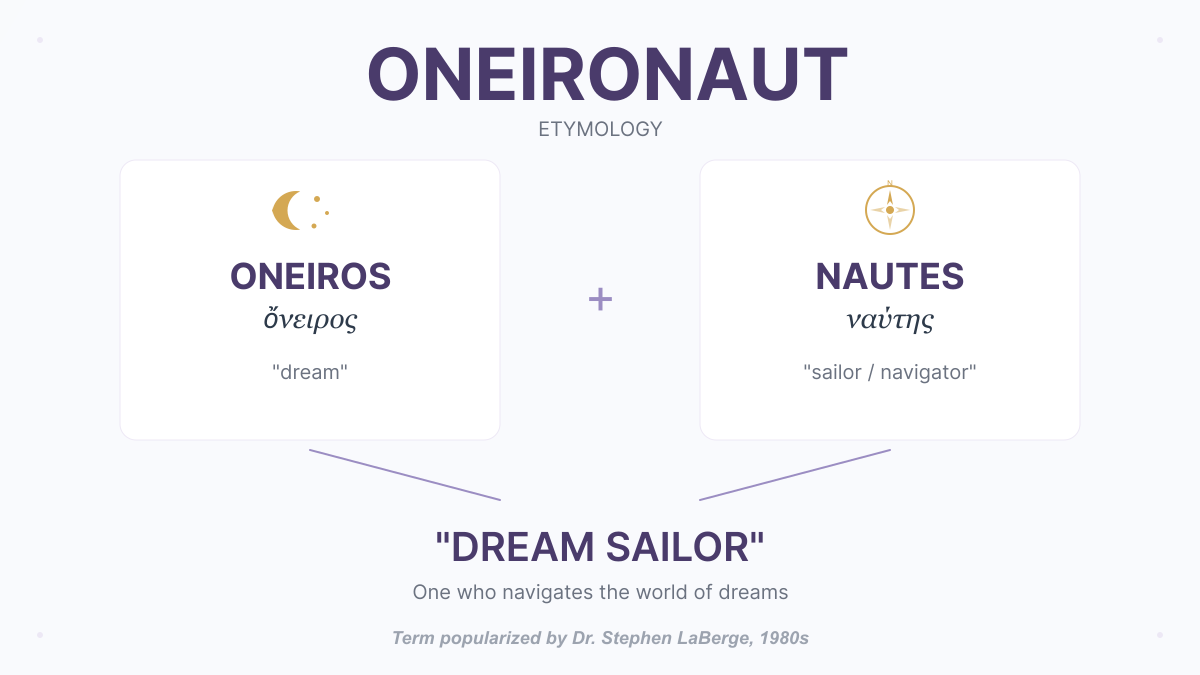
An oneironaut is a person who explores and navigates their dreams. The term comes from the Greek words oneiros (dream) and nautes (sailor or navigator), literally meaning "dream sailor."
Oneironauts approach dreams with the intentionality of explorers charting unknown territory. If astronauts journey through outer space, oneironauts voyage through inner space, deliberately navigating the landscapes of their own subconscious. This exploration encompasses many practices: lucid dreaming, dream incubation, detailed journaling, pattern analysis, and more.
The key distinction: An oneironaut practices systematic techniques, keeps detailed dream journals, and treats dream exploration as a learnable skill to develop over time. What matters is your intentional, exploratory approach to the dream world.
Oneironautics (the practice itself) combines ancient wisdom from traditions like Tibetan dream yoga with modern sleep science pioneered by researchers like Dr. Stephen LaBerge, who first popularized the term in the 1980s. The result is a research-backed approach to exploring the 8+ hours you spend dreaming each night.
I first encountered the term "oneironaut" in 2014 at the International Association for the Study of Dreams (IASD) conference in Berkeley, California. One of the authors of A Field Guide to Lucid Dreaming: Mastering the Art of Oneironautics was in attendance, and the word immediately resonated with me.
I'd been having notable dreams all my life and had already established a dream journaling practice, but I hadn't found the right language for what I was doing. "Oneironaut," a navigator of dreams, felt like the perfect fit. It captured something broader than just lucid dreaming: the intentional practice of working with dreams, exploring them systematically, whether you're consciously aware in them or not. The term gave identity to what I'd already been practicing without knowing what to call it.
Every night, your mind creates entire worlds. Oneironauts learn to wake up inside them.
Why does this matter? We spend roughly one-third of our lives sleeping, 25 to 30 years for the average person. Dreams are a fascinating and apparently unlimited aspect of that nighttime experience. For me, the question became simple: if I'm going to spend that much of my life in this state, why not explore it, learn from it, and develop a practice around it? Oneironautics transforms what could be unconscious downtime into a rich territory for discovery.
The Etymology: Where "Oneironaut" Comes From
The word "oneironaut" is built from two ancient Greek roots that perfectly capture the essence of dream exploration.
Oneiros (ὄνειρος) means "dream" in Greek. In ancient mythology, Oneiros was actually the personification of dreams—one of the thousand sons of Hypnos (Sleep) who would pass through gates of horn and ivory to visit sleepers. This root appears in other dream-related terms like oneirology (the study of dreams) and oneiromancy (dream divination).
Nautes (ναύτης) means "sailor" or "navigator"—someone who travels with purpose and skill. You'll recognize this suffix from familiar explorer terms:
- Astronaut - star sailor (traveling through space)
- Aquanaut - water sailor (exploring ocean depths)
- Psychonaut - mind sailor (exploring consciousness, often through meditation or psychedelics)
- Cosmonaut - universe sailor (the Russian term for space traveler)
The combination is elegant: a dream sailor, someone who doesn't just passively experience dreams but actively navigates them.
The Term's Modern Birth
Dr. Stephen LaBerge, the Stanford psychophysiologist who pioneered the scientific study of lucid dreaming, popularized "oneironaut" in the 1980s. In his groundbreaking research, he needed a term for the participants who were learning to consciously signal from inside their dreams using pre-arranged eye movements. "Lucid dreamer" felt too passive—these were people conducting experiments, exploring systematically, treating dreams as territories to map.
I appreciate the parallel with terms like "astronaut" and "psychonaut." It puts a clear name to the experience. Just as astronauts explore and examine the space outside of us, oneironauts explore and examine the space within. The "-naut" suffix carries weight: it implies purposeful navigation, systematic exploration, and a commitment to understanding unfamiliar territory. You're not just passively experiencing dreams; you're charting them.
The term caught on slowly but steadily. By the time Dylan Tuccillo and his co-authors published A Field Guide to Lucid Dreaming in 2013, "oneironaut" had become the preferred term for serious practitioners. It distinguished dedicated explorers from casual dreamers—the difference between a weekend hiker and an experienced mountaineer.
Why it matters: The etymology isn't just linguistic trivia. Calling yourself an oneironaut shapes how you approach your practice. Sailors need training, tools, and maps. They respect the seas they navigate. The term reminds us that dream exploration is a skill—one that requires both courage and discipline.
After my first lucid flight dream, I wanted to learn how to make it happen intentionally rather than just waiting for it to occur randomly. That shift to intentional practice is what the navigator mindset is about.
What Oneironauts Actually Do
Dream exploration encompasses a wide range of practices—from setting intentions before sleep to actively navigating lucid dreams to analyzing patterns across years of journaling.
Oneironauts approach dreams with intentionality. This might mean incubating a specific dream topic before sleep, keeping detailed journals to track patterns across hundreds of dreams, or becoming lucid to actively explore the dream environment. They treat the dream state as a vast territory with different regions to explore, each offering unique insights and experiences.
The practice of oneironautics encompasses six major types of exploration, each serving different purposes and appealing to different practitioners:
| Exploration Type | What It Involves | Common Activities | Who It's For |
|---|---|---|---|
| Creative Exploration | Using dreams as a canvas for artistic creation and imagination | Building architecture, composing music, painting landscapes, designing inventions | Artists, writers, designers, anyone seeking creative inspiration |
| Problem-Solving | Working through real-world challenges with dream logic and fresh perspectives | Rehearsing difficult conversations, exploring solution spaces, getting unstuck on projects | Professionals, students, anyone facing complex decisions |
| Self-Discovery | Exploring psychological landscapes, confronting fears, understanding yourself | Conversing with dream characters (parts of self), facing nightmares, exploring symbolism | Anyone interested in personal growth, therapy clients, spiritual seekers |
| Skill Practice | Rehearsing physical or mental skills in the dream environment | Practicing sports, public speaking, musical instruments, martial arts, language learning | Athletes, performers, anyone developing real-world skills |
| Pure Adventure | Experiencing the impossible and enjoying dream physics | Flying, teleportation, visiting fictional worlds, meeting historical figures, shapeshifting | Everyone—this is often where people start and what keeps practice fun |
| Scientific Experimentation | Testing hypotheses about consciousness, perception, and dream mechanics | Reality testing within dreams, observing dream physics, documenting patterns | Curious minds, researchers, philosophy enthusiasts |
The Multifaceted Practice
What makes oneironautics distinct is that practitioners don't limit themselves to just one type of exploration. A single dream might begin with pure adventure (flying through a cityscape), transition to creative exploration (designing a building you encounter), and end with self-discovery (having a meaningful conversation with a dream character).
In my own practice, I'm most drawn to self-discovery, experimentation, and practicing awareness. I use dreams to explore aspects of my psyche, test hypotheses about how dreams work, and refine my ability to maintain lucid awareness.
The key difference from casual dreaming is documentation and intention. Oneironauts typically:
- Set exploration goals before sleep: "Tonight I want to dream about my creative project" or "I'll ask a dream character what they represent"
- Keep detailed dream journals: Not just "I had a weird dream," but detailed records tracking themes, symbols, emotions, and patterns
- Practice dream incubation: Using techniques to influence dream content—planting questions or topics before sleep
- Track patterns over time: Noticing that certain locations recur, specific symbols appear during particular life situations, or emotional themes that connect dreams to waking life
- Share discoveries: Contributing to online communities, discussing exploration techniques, helping others learn
This systematic approach transforms dreaming from passive experience into a genuine practice—one that reveals as much about waking consciousness as it does about dreams.
Through years of systematic journaling, I started noticing patterns I would have missed otherwise: trends in when nightmares occurred, which supplements or medications improved dream recall, how what I watched during the day influenced my dreams, and connections between certain dream themes or symbols and events in my waking life. These insights only emerged because I was tracking consistently over time.
How to Become an Oneironaut: Step-by-Step Guide
Becoming an oneironaut is about developing a consistent, systematic approach to dream exploration. The foundation is always the same: dedicated dream journaling, pattern recognition, and intentional practice. From there, many oneironauts pursue lucid dreaming as a way to explore more directly.
This section focuses on lucid dreaming techniques because they're the most researched and offer direct exploration capability. These techniques build on the foundational practices of journaling and dream analysis that all oneironauts use.
The good news: lucid dreaming is a learnable skill. Research shows that with proper training, most people can achieve their first lucid dream within 2-8 weeks, with consistency developing over 3-6 months of practice.
The Foundation: Dream Recall
Before you can become lucid in dreams, you need to remember your dreams in the first place. Dream recall is the absolute foundation of oneironaut practice. If you don't remember your dreams, you won't remember becoming lucid either.
Start here:
- Keep a dream journal by your bed
- Write down anything you remember immediately upon waking
- Even fragments count: "blue room," "talking to someone," "felt anxious"
- Aim for remembering at least 1 dream per night within 2 weeks
Once you're consistently recalling dreams, you're ready to learn induction techniques.
Lucid Dream Induction Techniques
| Technique | Full Name | Difficulty | Best For | Time to First Success | How It Works |
|---|---|---|---|---|---|
| MILD | Mnemonic Induction of Lucid Dreams | Beginner-friendly | Most people, especially beginners | 1-4 weeks | Set intention before sleep: "Next time I'm dreaming, I'll recognize I'm dreaming" + visualization |
| DILD | Dream-Initiated Lucid Dream | Easiest (but passive) | Complete beginners | Varies (can be immediate or never) | Spontaneously becoming lucid during a dream via noticing dream signs or anomalies |
| WBTB | Wake-Back-to-Bed | Intermediate | People with flexible schedules | 1-2 weeks | Wake after 4-6 hours of sleep, stay awake 20-30 min, return to sleep with lucid intention |
| WILD | Wake-Initiated Lucid Dream | Advanced | Experienced meditators, patient practitioners | 2-6 months | Maintain consciousness while body falls asleep; transition directly from waking to lucid dreaming |
| Reality Checks | N/A (supporting technique) | Beginner-friendly | Everyone (use with other techniques) | Ongoing practice | Habitually question reality during the day so the habit carries into dreams |
| Dream Journaling | N/A (foundational practice) | Essential for all | Everyone—prerequisite for all techniques | Immediate benefit for recall | Write dreams upon waking to improve recall and identify personal dream signs |
Key Insight: MILD + WBTB + Dream Journaling is the most effective combination for beginners, with success rates significantly higher than any single technique alone.
Your First 30 Days: A Practical Timeline
Week 1-2: Build dream recall foundation
- Journal every morning, even if you remember nothing (write "no recall")
- Go to bed and wake up at consistent times
- Avoid alcohol and cannabis (they suppress REM and dream recall)
- Goal: Remember at least 1 dream per night
Week 2-3: Add MILD technique
- As you fall asleep, repeat: "Next time I'm dreaming, I'll recognize I'm dreaming"
- Visualize yourself becoming lucid in a recent dream
- Practice 10-15 minutes before sleep
- Continue daily journaling
Week 3-4: Add reality checks
- Ask "Am I dreaming?" 10+ times per day
- Actually check: read text twice, look at hands, question your surroundings
- Do reality checks during unusual or emotional moments
- The habit will carry into dreams
Week 4+: Combine WBTB with MILD
- Set alarm for 5-6 hours after falling asleep
- Stay awake for 20-30 minutes (read about lucid dreaming, review journal)
- Return to sleep while practicing MILD
- This timing targets REM-heavy sleep cycles
Looking back, I probably had my first lucid dream within six months of starting to journal my dreams every morning. I wasn't actively trying to lucid dream at that point, I was focused on meditation and dream documentation. Reality checks are, in my opinion, the easiest way to integrate that state of awareness into your day so it carries into your night. One important lesson: always prioritize sleep quality before dream practice. That foundation is essential for sustainability and integration over the long term.
The Mindset Shift: From Dreamer to Oneironaut
The transition from "passive dreamer" to "oneironaut" happens gradually. It's marked by:
- Intentionality: Setting goals for your dream life and exploration practice
- Curiosity over passivity: Asking "what can I learn from this dream?" instead of dismissing it upon waking
- Pattern recognition: Noticing your personal dream signs, recurring themes, and symbolic language
- Systematic documentation: Treating your dream journal as a research log, not just a casual diary
- Exploration over control: Approaching dreams with curiosity about what they reveal rather than just manipulating them
- Community engagement: Sharing experiences, learning from others, contributing to collective knowledge
- Long-term commitment: Understanding this is a practice you'll develop over years, not weeks
You don't need permission to call yourself an oneironaut. If you're approaching dreams with intention, curiosity, and systematic practice—you're already on the path.
When I first heard the term at the 2014 IASD conference, I immediately recognized it described what I was already doing. I was already an intentional dream explorer and lucid dreamer, the term just gave it a name. In my view, if you consider yourself a dream navigator, you're an oneironaut. The label is there for anyone who approaches their dreams with that intentional, exploratory mindset.
Continue Your Oneironaut Journey
Ready to explore your dreams? Here are your next steps:
- Start tonight: Begin keeping a dream journal to build recall
- Learn the techniques: Discover 7 oneironaut exploration techniques for systematic dream work
- Master lucidity: Our complete MILD guide walks you through the most effective beginner method
- Understand the distinction: Learn how oneironauts differ from lucid dreamers
- Get inspired: Read about famous oneironauts who pioneered dream exploration
- Improve recall: Read our guide on advanced dream recall techniques
- Optimize sleep: Learn about sleep hygiene for dream recall
- Go deeper: Explore our complete lucid dreaming guide
The dream world awaits. Every night, you have the opportunity to explore it.