Oneironaut vs Lucid Dreamer: What's the Difference? (2025)
Is an oneironaut the same as a lucid dreamer? No. Oneironautics is the discipline of intentional dream exploration. Lucid dreaming is one technique within it. Learn how these terms relate.
Oneironaut Team · December 1, 2025 · 10 min read
Quick Answer
An oneironaut is anyone who explores dreams intentionally. Oneironautics is the discipline of intentional dream exploration. Lucid dreaming is one powerful technique within oneironautics, but it's not required. You can be an oneironaut through dream journaling, incubation, pattern analysis, or dream sharing without ever achieving lucidity.
At a Glance
The Short Answer
We would consider someone who journals their dreams, tracks recurring symbols, and uses incubation to explore specific questions, yet has never achieved lucidity, an oneironaut.
Oneironautics is the discipline of intentional dream exploration. An oneironaut is anyone who practices it. Lucid dreaming (becoming aware that you're dreaming while still in the dream) is one powerful technique within oneironautics.
I know a teacher who has been involved with intentional dream practice for over 30 years and has never had a lucid dream. You can begin meaningful dreamwork tonight with nothing more than a journal and intention.
This article breaks down exactly how these terms relate, why they get confused, and how to think about your own practice.
Defining the Terms
Oneironaut
The word comes from Greek: oneiros (ὄνειρος) meaning "dream" and nautes (ναύτης) meaning "sailor" or "navigator." The same -naut suffix appears in astronaut (star sailor), aquanaut (water sailor), and psychonaut (mind sailor).
This etymology matters. The word itself emphasizes navigation and exploration, not any specific technique for getting there. An astronaut is defined by the territory they explore, not by whether they arrived via rocket or space shuttle.
An oneironaut is someone who engages with dreams intentionally and systematically. The reasons vary widely: self-discovery, creative inspiration, problem-solving, emotional healing, spiritual practice, or simple curiosity about what the mind does while we sleep.
I think the term is a playful way to categorize a dream practice.
Oneironautics
Oneironautics is the practice or discipline of intentional dream exploration. It's the umbrella that contains multiple approaches, techniques, and traditions.
Here's an analogy that clarifies the relationship: oneironautics is to lucid dreaming as athletics is to running. Athletics is the broader discipline. Running is one event within it. A runner is an athlete, but you don't have to run to be an athlete. The discipline contains the technique, not the other way around.
Oneironautics encompasses journaling practices, incubation methods, symbol analysis, lucid dreaming techniques, and more. Someone can practice oneironautics for years without ever becoming lucid in a dream.
Lucid Dreaming
Lucid dreaming is the specific experience of becoming aware that you're dreaming while still inside the dream. That awareness can range from a faint recognition ("wait, this might be a dream") to full clarity with the ability to make deliberate choices within the dreamscape.
It's a powerful technique. Lucidity offers direct access to the dream environment, in-dream agency, and often heightened vividness. For certain types of exploration, nothing else compares.
But it remains one technique among several. Lucid dreaming is a destination some oneironauts pursue and a tool many find valuable. It is not the definition of the practice itself.
How They Relate
The relationship is nested: oneironautics is the discipline, oneironaut is the practitioner, and lucid dreaming is one technique within the discipline's toolkit.
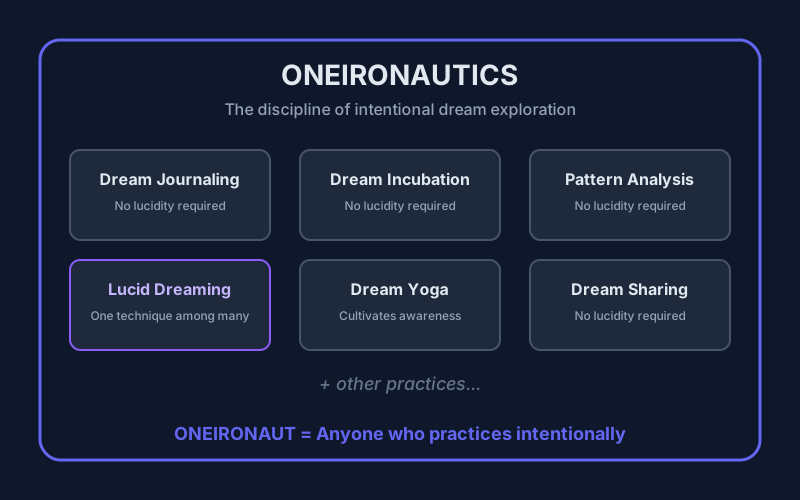
In the next section, we'll break down the full range of oneironaut practices side by side, so you can see exactly where lucid dreaming fits among the other approaches.
The Oneironaut's Toolkit
Oneironautics isn't a single practice. It's a collection of approaches, each offering a different way to explore your dream life. Some require months of training. Others you can start tonight.
The table below compares six core practices. Notice that lucid dreaming is just one column among six. All of these are legitimate paths.
| Dream Journaling | Dream Incubation | Lucid Dreaming | Pattern Analysis | Dream Yoga | Dream Sharing | |
|---|---|---|---|---|---|---|
| What It Is | Recording dreams upon waking to build recall and capture material | Setting intentions before sleep to influence dream content | Becoming aware you're dreaming while still in the dream | Reviewing journal entries to identify recurring symbols and themes | Tibetan Buddhist practice of maintaining awareness through sleep and dream states | Discussing dreams with others in pairs or groups to gain perspective and insight |
| Requires Lucidity? | No | No | Yes | No | Cultivates it, but begins with waking practices | No |
| Time to Start | Tonight | Tonight | Weeks to months | After 1-2 weeks of journaling | Today (foundational practices), but deepens over years | Tonight (if you have someone to share with) |
| Best For | Building recall, capturing raw material, developing consistency | Targeting specific questions, creative problem-solving, seeking guidance | Direct in-dream exploration, real-time experiments, confronting fears | Self-understanding, tracking personal growth, discovering meaning | Spiritual development, awareness training, exploring the nature of mind | Community connection, fresh perspectives, discovering blind spots |
Most practicing oneironauts don't pick just one approach. Journaling builds the foundation. Incubation adds direction. Pattern analysis deepens understanding. Lucid dreaming opens new possibilities. Dream yoga cultivates awareness across all states. Dream sharing brings outside perspective. These practices reinforce each other, and there's no required sequence. Start wherever you feel drawn. For specific methods, see our guide to oneironaut techniques.
Why "Oneironaut" and "Lucid Dreamer" Often Get Used Interchangeably
The association between these terms has a specific history, and understanding it helps explain why they're often treated as synonyms today.
The LaBerge Connection
In the 1980s, Dr. Stephen LaBerge conducted groundbreaking research at Stanford that proved lucid dreaming was real and scientifically measurable. His subjects learned to signal from inside their dreams using predetermined eye movements. LaBerge needed a word for these trained dream explorers, and "oneironaut" fit naturally.
As lucid dreaming entered mainstream awareness, "oneironaut" came along with it, but almost always in that specific context. Later publications reinforced the link. When Tuccillo, Zeizel, and Peisel titled their 2013 book A Field Guide to Lucid Dreaming: Mastering the Art of Oneironautics, it strengthened the impression that oneironautics and lucid dreaming were essentially the same thing.
Pop Culture and Marketing
Lucid dreaming lends itself to compelling headlines. "Control your dreams" is more attention-grabbing than "Keep a thoughtful dream journal." Media coverage naturally gravitates toward the flashier technique.
This emphasis shapes how people discover dreamwork. Apps, courses, and books often position lucid dreaming as the primary goal. Other approaches, some of which are more accessible and equally rewarding, tend to receive less attention as a result.
Our Position on This
People can use these terms however they like. Language evolves, and there's no single authority on dreamwork vocabulary.
At Oneironauts.io, we see "oneironaut" as the more inclusive term. Anyone working with their dreams and exploring them with intention could be an oneironaut. You don't need to achieve lucidity first. You don't need special skills. If you're engaging with your dream life deliberately, whether through journaling, incubation, sharing, or yes, lucid dreaming, that's oneironautics. That's our perspective, and we want to be transparent about it.
The Lucid Dreaming Question
Can You Be an Oneironaut Without Lucid Dreaming?
Yes.
Look back at the toolkit table. Five of six practices we listed don't require lucidity at all. Dream journaling, incubation, pattern analysis, dream yoga's foundational practices, and dream sharing are all legitimate oneironaut work. Lucid dreaming is one path, not the path.
History supports this view. The ancient Greeks practiced dream incubation at Asklepion temples, sleeping in sacred spaces to receive healing or guidance through dreams. Indigenous cultures across the world developed sophisticated dreamwork traditions centered on sharing, interpretation, and community meaning-making. These practices existed long before "lucid dreaming" was even a term. The practitioners weren't waiting for lucidity. They were already exploring.
Many insights from dreamwork come not from in-dream awareness but from what happens after waking: the journaling, the reflection, the slow recognition of patterns over months or years. The meaning often emerges in the review, not the experience itself.
I mentioned earlier the teacher with 30 years of intentional dream practice who has never had a lucid dream. That's not a failure or a limitation. It's simply one oneironaut's path among many.
What About Lucid Dreaming for Entertainment?
Some people pursue lucid dreaming purely for fun. Flying through cities, meeting celebrities, living out fantasy scenarios, experiencing things impossible in waking life. These are common and completely valid reasons to explore lucidity.
Is that oneironautics? We'd say it still falls under the umbrella. You're engaging with your dreams intentionally, even if the intention is enjoyment rather than insight. But ultimately, the term is up to the experiencer. Some people who lucid dream for entertainment might not resonate with "oneironaut" at all, and that's fine. Labels are tools, not requirements.
What we'd suggest is that there's a meaningful difference between entertainment-focused lucid dreaming and exploration-focused dreamwork. Same technique, different intention. A camera can be used to take vacation selfies or to document a war zone. Neither use is wrong, but they're different activities.
Many lucid dreamers find that what starts as entertainment naturally evolves into something deeper. The fun doesn't go away, but curiosity creeps in. That's a common path into broader oneironautics.
Where the Paths Converge
In practice, these paths often meet. Serious lucid dreamers usually develop broader practices like journaling and analysis to support their work. Committed oneironauts frequently explore lucid dreaming as one tool among several. The boundaries blur, and that's perfectly natural.
What Kind of Dream Explorer Are You?
These questions are meant to help you reflect on where you are right now and what draws you to this work.
How do you currently engage with your dreams? Do you remember them most mornings, or do they slip away? Have you ever kept a dream journal? Do you talk about your dreams with anyone, or do they stay private?
What draws you to dream exploration? Are you seeking insight into yourself or your life? Looking for creative inspiration? Curious about what your mind does while you sleep? Hoping to process emotions or work through something? Drawn to the adventure of it? Most people have more than one reason, and reasons often shift over time.
What's your relationship to lucid dreaming? Is it something you're actively pursuing? Something you're curious about but haven't tried? Something you've experienced and want to deepen? Or something that doesn't particularly interest you?
What would meaningful progress look like for you? Remembering more dreams? Understanding recurring patterns? Achieving your first lucid dream? Feeling more connected to your inner life? Having dreams that help you creatively?
If you're engaging with your dreams with any degree of intention, you're practicing oneironautics. There's no hierarchy among approaches, and lucid dreaming is just one option among many. Start with what resonates and let your practice develop from there.
Start Exploring
Oneironautics is the discipline of intentional dream exploration. An oneironaut is anyone who practices it. Lucid dreaming is one powerful technique within the discipline, but it's not required. You can begin tonight with nothing more than a notebook by your bed and the intention to remember what you dream.
If you're new to dreamwork: Start with dream journaling. It's the foundation most oneironauts build on. How to Start a Dream Journal
If you're already exploring: Learn more about what defines this practice. What Is an Oneironaut?
If you're interested in lucid dreaming: The MILD technique is one of the most reliable methods for beginners. MILD Technique Guide
If you want to go deeper: Explore the full range of oneironaut techniques. Oneironaut Techniques
Whatever path you choose, the dreams are already there waiting.