MILD Technique: 54% Success Rate Guide to Lucid Dreaming (2026)
Learn the MILD lucid dreaming technique developed by Stanford's Stephen LaBerge. 54% success rate with WBTB. Step-by-step guide with timing, troubleshooting, and optimization tips.
Oneironaut Team · November 11, 2025 · 39 min read
Quick Answer
MILD (Mnemonic Induction of Lucid Dreams) is a lucid dreaming technique developed by Stephen LaBerge in 1980 that uses prospective memory—remembering to do something in the future—to trigger lucidity. The technique involves: recalling a recent dream, identifying a dream sign, visualizing becoming lucid in that dream, and repeating the intention 'Next time I'm dreaming, I will remember I'm dreaming' while falling asleep. Research shows MILD combined with WBTB produces lucid dreams in 54% of participants, making it one of the most scientifically validated techniques.
At a Glance
What if you could remember to realize you're dreaming, just like you remember to buy milk on the way home or call someone tomorrow? That's not wishful thinking. It's applied cognitive science.
MILD—Mnemonic Induction of Lucid Dreams—uses the same mental process you use dozens of times daily: prospective memory. When you tell yourself "I need to remember to take my keys when I leave," you're setting a future intention. Your brain already knows how to do this. MILD just applies that skill to dream awareness.
Stanford researcher Stephen LaBerge developed MILD back in 1980. It's probably the most scientifically validated lucid dreaming technique we have. Research published in BMC shows that when combined with Wake Back to Bed (WBTB), MILD produces lucid dreams in 54% of participants. And these weren't experienced lucid dreamers—just regular people learning the technique.
This comprehensive guide walks you through every aspect of MILD: what it is, how it works, the exact steps to practice it, when to practice for best results, common mistakes that sabotage success, and how to troubleshoot when progress stalls. Whether you're completely new to lucid dreaming or have tried other techniques without success, MILD offers a proven, accessible path to conscious dreaming.
What is the MILD Technique?
MILD stands for Mnemonic Induction of Lucid Dreams. At its core, it's a memory-based technique that trains your brain to remember to recognize when you're dreaming while you're in the dream.
The technique works by engaging prospective memory, which is your ability to remember to do something in the future. You use prospective memory constantly:
- Remembering to reply to an email later today
- Taking medication at a specific time
- Picking up groceries on the way home
- Calling someone tomorrow
These aren't random spontaneous memories. They're intentional memory triggers you've set. Your brain has a sophisticated system for these future-oriented memories. MILD hijacks this system for lucid dreaming.
How MILD Works (The Cognitive Science)
When you practice MILD, you're essentially programming a prospective memory trigger: "Next time I'm dreaming, I will remember I'm dreaming."
But MILD goes beyond simple affirmation. It combines several cognitive techniques:
- Dream recall - Actively remembering a recent dream provides a concrete scenario
- Pattern recognition - Identifying dream signs (unusual elements) trains pattern matching
- Visualization - Mentally rehearsing becoming lucid creates neural pathways
- Intention-setting - Repeating your intention while falling asleep embeds the trigger
- Memory consolidation during REM - Practicing during WBTB hits the optimal window when your brain consolidates memories and enters REM sleep
This multi-layered approach makes MILD significantly more effective than simple affirmations or hoping you'll "just realize" you're dreaming.
History: Stanford's Gift to Lucid Dreaming
Stephen LaBerge developed MILD at Stanford University while researching the physiological reality of lucid dreaming. In his 1980 doctoral dissertation, he documented the technique's effectiveness through sleep laboratory studies.
LaBerge's key insight was that lucid dreams required a specific type of memory activation: recognizing an ongoing state rather than recalling past events. By framing lucid dreaming as a prospective memory task, he transformed it from mystical pursuit to learnable skill.
Over 40+ years, MILD has been refined, tested, and validated across multiple sleep laboratories. It remains the gold standard for scientifically-validated lucid dream induction.
How MILD Works (The Cognitive Science)
Understanding why MILD works helps you practice it correctly. The technique leverages several interconnected brain systems.
Prospective Memory: Your Brain's "Remember to Remember" System
Prospective memory has two types:
- Time-based - "I need to take my medication at 8pm"
- Event-based - "When I see the grocery store, I need to stop"
MILD uses event-based prospective memory. The "event" is a dream sign (unusual element in a dream), and the "action" is reality testing or recognizing you're dreaming.
Research shows event-based prospective memory is particularly effective because it doesn't rely on tracking time. It activates when you encounter the trigger. Since dreams are full of bizarre events, they provide constant trigger opportunities once you've trained yourself to recognize them.
The Role of Sleep Architecture
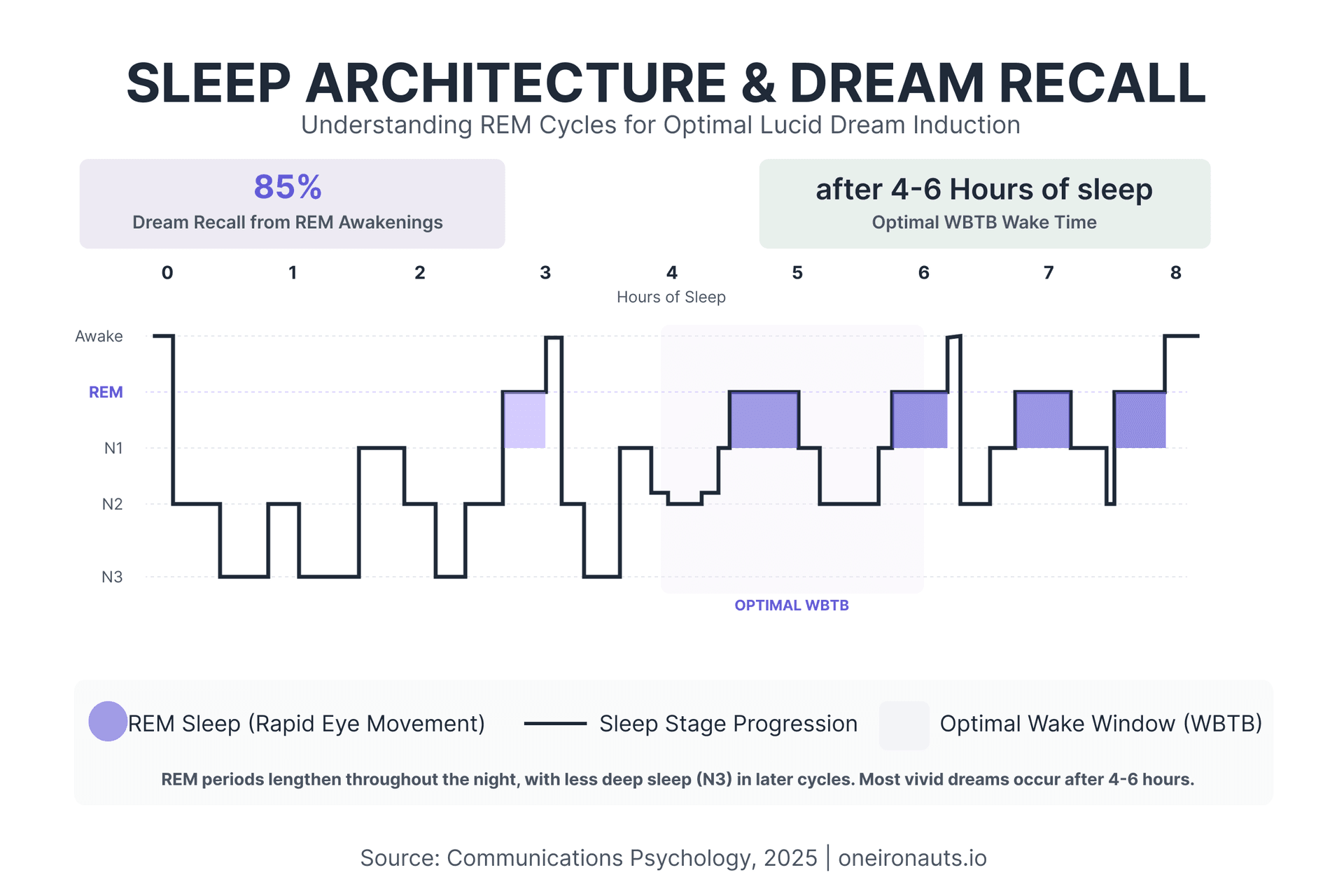
MILD works best when practiced during or immediately before REM sleep, when dreams are most vivid and lucid dreams most likely to occur. This is why MILD is typically combined with Wake Back to Bed (WBTB):
- First 3-4 hours of sleep: Mostly deep sleep, minimal dreaming
- After 4-5 hours: REM periods lengthen dramatically
- Final REM periods: Can last 30-60 minutes with intense, narrative dreams
Practicing MILD after waking from 4-6 hours of sleep means your intention is fresh in working memory as you enter your longest, most vivid REM periods.
Neural Pathway Formation
When you repeatedly visualize becoming lucid in a dream scenario, you're creating and strengthening neural pathways. Your brain doesn't clearly distinguish between real and vividly imagined experiences, which is why mental rehearsal works for athletes, musicians, and now, lucid dreamers.
Each time you mentally rehearse recognizing a dream sign and becoming lucid, you're making that neural pathway more automatic. With consistent practice, the recognition and lucidity trigger become more reflexive.
Prerequisites: What You Need Before Starting MILD
MILD isn't difficult, but it does require a foundation. Jumping straight into MILD without these prerequisites is like trying to run before you can walk. Technically possible, but success rates plummet.
1. Strong Dream Recall (Essential)
You need to remember at least 1 dream most mornings before starting MILD. Here's why:
- MILD requires recalling a recent dream to visualize and identify dream signs
- If you don't remember dreams, you have no raw material to work with
- Even if MILD induces lucidity, you won't remember it happened
If your recall is poor (fewer than 1 dream per week), spend 2-4 weeks building it with:
- Dream journaling immediately upon waking
- Setting the intention "I will remember my dreams" before sleep
- Staying completely still when you wake to catch fading dreams
- Getting sufficient sleep (7-9 hours)
Read our complete dream recall guide here.
2. Dream Journal with 20-30 Entries
A populated dream journal serves multiple purposes for MILD:
- Pattern recognition - You can identify your recurring dream signs
- Concrete scenarios - You have real dreams to visualize for MILD practice
- Progress tracking - You can note when lucidity attempts occur
Your journal doesn't need perfect prose. Bullet points work fine. Focus on:
- Dream narrative (what happened)
- Unusual elements (dream signs)
- Emotions and sensations
- Any moments where you almost realized you were dreaming
3. Understanding Dream Signs
Dream signs are unusual elements that should tip you off you're dreaming. They fall into several categories:
- Context - Wrong location, impossible situation
- Awareness - Thoughts/feelings that wouldn't happen in waking life
- Form - You or others look different, unusual abilities
- Action - Doing things you can't normally do (flying, walking through walls)
Review your dream journal and identify your most common dream signs. These become your MILD targets: the events you'll train yourself to recognize.
4. Basic Reality Check Habit (Helpful but Optional)
While not strictly required, practicing reality checks during the day amplifies MILD effectiveness. Reality checks are quick tests to verify if you're dreaming:
- Pushing a finger through your palm
- Reading text twice (it changes in dreams)
- Pinching your nose and trying to breathe
- Checking digital displays (they're unstable in dreams)
Each time, genuinely ask yourself: "Am I dreaming right now?" This mental habit carries into dreams, making the MILD intention more likely to trigger.
Learn the full reality check method →
Self-Assessment: Are You Ready for MILD?
Check all that apply:
-
□ I remember at least 1 dream most mornings
-
□ I have a dream journal with 20+ entries
-
□ I can identify at least 3 recurring dream themes or signs
-
□ I understand what dream signs are
-
□ I'm willing to practice MILD every night for 2-4 weeks minimum
-
□ I get 7+ hours of sleep most nights
-
□ I'm willing to use WBTB (waking during night) for best results
5-7 checks: You're ready to proceed to MILD practice
3-4 checks: Build recall and journaling for 1-2 more weeks
0-2 checks: Focus on dream recall fundamentals for 3-4 weeks first
The MILD Technique: Complete Step-by-Step Guide
MILD consists of five specific steps performed while lying in bed, either before initial sleep or (ideally) after waking during the night via Wake Back to Bed. Each step matters. Skipping or rushing through any step reduces effectiveness.
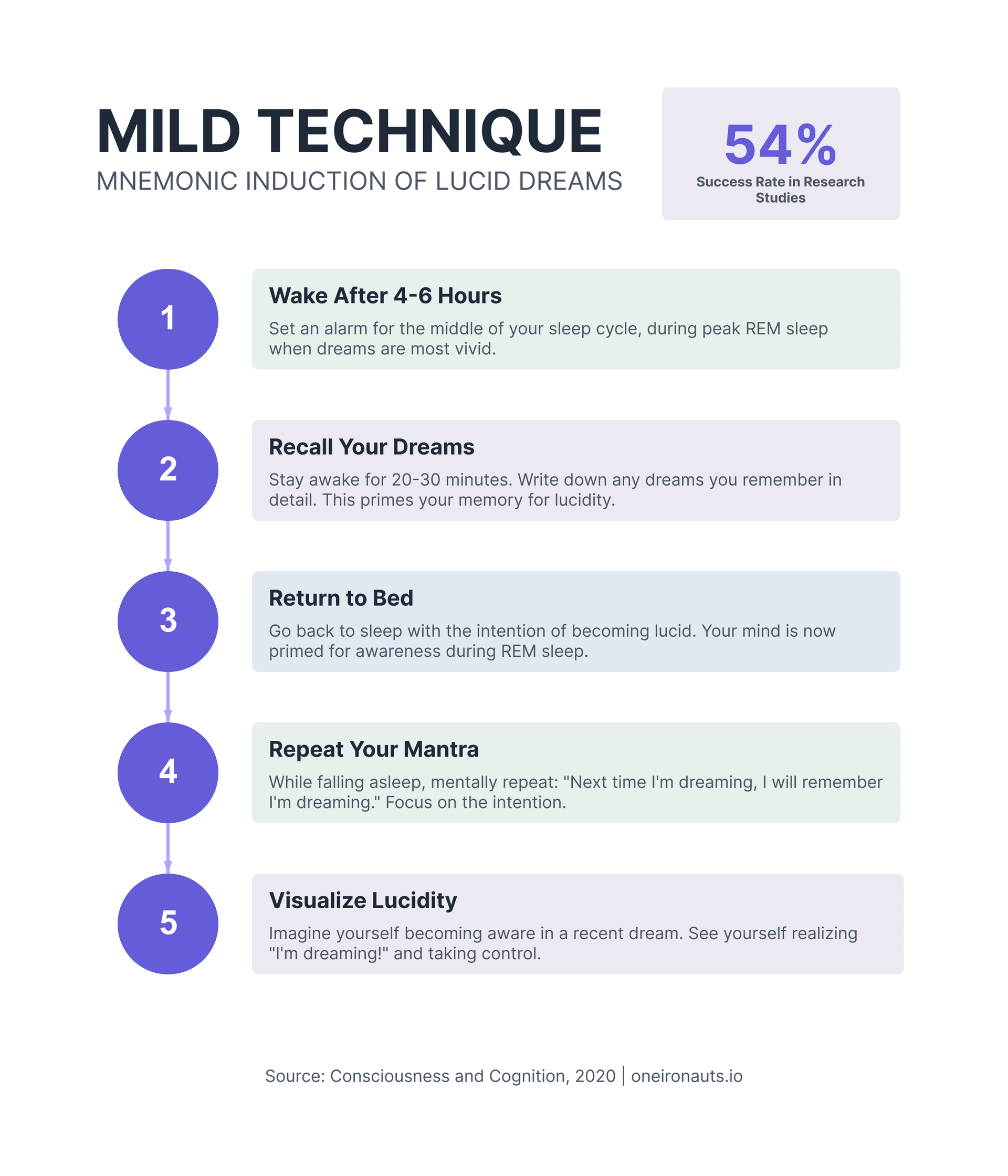
Step 1: Recall Your Last Dream
As you lie in bed ready to fall asleep, recall your most recent dream in as much detail as possible. This could be:
- A dream you just woke from (if practicing with WBTB)
- Your last remembered dream from earlier that night
- A vivid dream from the previous night if nothing else is fresh
What to focus on:
- The narrative flow (what was happening)
- The setting and environment
- Who was present
- Any unusual or bizarre elements (dream signs)
- How you felt during the dream
Don't worry if details are fuzzy. Work with what you have. The act of engaging memory retrieval is what matters.
Common mistake: Skipping this step and jumping straight to visualization. Dream recall primes your memory systems and provides concrete material for the next steps.
Step 2: Identify the Dream Sign
Within your recalled dream, identify at least one dream sign: an element that should have tipped you off you were dreaming.
Examples of dream signs:
- You were back in high school despite being an adult
- A deceased person was alive and present
- You could fly or had superpowers
- The location was a bizarre hybrid (your childhood home merged with your office)
- Technology didn't work properly
- You changed locations instantly without traveling
Choose the most obvious or emotionally striking dream sign. This becomes your trigger.
Why this matters: You're training your brain to recognize these patterns. The more you consciously identify dream signs during recall, the more likely you'll recognize them during future dreams.
Step 3: Visualize Becoming Lucid
This is where the magic happens. Mentally replay the dream, but this time, imagine yourself recognizing the dream sign and becoming lucid.
How to visualize effectively:
- Return to the dream moment - Picture yourself back in the dream just before or during the dream sign
- Notice the dream sign - In your visualization, clearly recognize "Wait, that's impossible! I must be dreaming!"
- Feel the realization - Experience the moment of lucidity as vividly as possible
- Perform a reality check - Visualize doing a reality check to confirm you're dreaming
- Experience the lucid dream - Imagine what you'll do once lucid (fly, explore, etc.)
Key principle: Visualization should feel real. You're not passively watching yourself. You're experiencing it first-person, as if you're actually there becoming lucid.
How long: 30-60 seconds minimum. You can cycle through the visualization multiple times.
Common mistake: Vague, half-hearted visualization. Your brain responds to vivid, emotionally engaging mental rehearsal, not abstract concepts.
Step 4: Set Your Intention
As you continue lying in bed, mentally repeat your intention to recognize you're dreaming. The classic MILD mantra is:
"Next time I'm dreaming, I will remember I'm dreaming."
Alternative mantras:
- "When I dream, I'll know I'm dreaming"
- "I recognize my dreams"
- "The next time I see [specific dream sign], I'll realize I'm dreaming"
How to repeat effectively:
- Repeat the phrase slowly and meaningfully (not mechanically)
- Focus on the intention behind the words—you genuinely mean this
- Allow natural pauses between repetitions
- Continue until you start drifting into sleep
How many times: There's no magic number. Some people repeat 5-10 times, others 50+. What matters is falling asleep while holding the intention, not hitting a count.
Common mistake: Repeating mindlessly like a bored mantra. Your brain responds to genuine intention, not robotic repetition. Each repetition should feel meaningful.
Step 5: Fall Asleep While Holding the Intention
This is the crucial final step: drift into sleep while still holding your intention to remember you're dreaming.
Practical tips:
- Don't force staying awake—let sleep come naturally
- If your mind wanders to other thoughts, gently return to the intention
- You might cycle between visualization and mantra as you drift off
- The transition from wakefulness to sleep should blur with intention still present
What success feels like: You fall asleep still thinking "I will remember I'm dreaming" or visualizing becoming lucid. The intention is the last thing in your conscious mind before sleep.
Common mistake: Giving up on the intention too early and letting your mind wander to random thoughts. The goal is for the MILD intention to be your last conscious thought before falling asleep.
Build the habit that makes MILD work: Reality Check: Lucid Dreams sends customizable reality check reminders throughout the day—the daytime practice that research shows amplifies MILD success. Free on iOS →
Not sure which technique is right for you?
Take the 2-minute Technique Quiz to get a personalized recommendation based on your sleep patterns and experience level.
Take the QuizWhen to Practice MILD: Timing for Maximum Success
MILD can technically be practiced at any sleep onset, but timing dramatically affects success rates. Here's the hierarchy from most to least effective.
Option 1: MILD After WBTB (Highest Success - 54%)
The gold standard approach—this is what produced 54% success in research studies.
How it works:
- Set an alarm for 4-6 hours after falling asleep (or wake naturally during the night)
- Wake up fully and stay awake for 15-30 minutes
- During this time, review your dreams, read about lucid dreaming, or do something engaging but calming
- Return to bed and practice all 5 MILD steps as you fall back asleep
Why this timing works:
- Your longest, most vivid REM periods occur in the final hours of sleep
- Dreams are more bizarre (more dream signs to recognize)
- Your working memory is active but body is tired, creating ideal conditions
- The intention is fresh in mind as you enter REM sleep
Practical considerations:
- This disrupts sleep, which isn't for everyone
- Best on nights when you can sleep in and recover
- Start with shorter wake periods (10-15 minutes) and adjust
Success rate: This timing accounts for the 54% success rate in studies. If you only practice MILD one way, use this timing.
For the complete WBTB protocol including wake period optimization, see our WBTB technique guide.
Option 2: MILD After Natural Awakening (Good Success)
If setting an alarm feels too disruptive, practice MILD whenever you naturally wake during the night (most people wake 3-5 times per night without realizing).
How it works:
- When you wake naturally during the night, don't move or open your eyes fully
- Recall the dream you just had (it will be fresh)
- Practice the 5 MILD steps as you fall back asleep
Advantages:
- No alarm needed
- Less sleep disruption
- Practices MILD during natural REM cycles
Disadvantage:
- Requires awareness during nighttime awakenings
- May be harder to stay awake long enough to practice properly
Success rate: Lower than WBTB (maybe 30-40%) but better than bedtime-only practice
Option 3: MILD at Initial Bedtime (Moderate Success)
Practicing MILD as you fall asleep at the start of the night.
How it works:
- Recall a dream from earlier (that day or recently)
- Practice all 5 MILD steps as you fall asleep
Advantages:
- No sleep disruption
- Easiest to maintain as a nightly habit
- Can still produce results, especially for natural frequent dreamers
Disadvantages:
- Fewer REM periods in first half of sleep
- REM periods are shorter and less vivid early in the night
- Lower success rate overall
Success rate: Estimated 15-25%, significantly lower than WBTB timing
When it works best: For people with naturally high dream recall who already occasionally experience spontaneous lucidity
Option 4: MILD for Afternoon Naps (Moderate Success)
Nap-based MILD can be surprisingly effective because:
- You enter REM sleep faster during naps (especially if slightly sleep-deprived)
- Nap dreams tend to be vivid and bizarre
- Your mind is more alert during the day, making intention-setting clearer
How it works:
- Nap 60-90 minutes after some period of wakefulness (at least 4-5 hours awake)
- Practice MILD as you fall asleep
- Set a gentle alarm for 60-90 minutes if needed
Best conditions for nap MILD:
- Slightly sleep-deprived (makes REM more likely)
- Afternoon timing (2-4pm)
- After mentally engaging activities (studying, work)
Success rate: Comparable to initial bedtime MILD (15-25%), but with less sleep disruption to your main sleep cycle
MILD vs Other Lucid Dreaming Techniques: Complete Comparison
Choosing the right lucid dreaming technique depends on your sleep style, experience level, and time commitment. Here's how MILD compares to other popular induction methods.
Technique Comparison Table
| Technique | Success Rate | Difficulty | Time to Results | Best Timing | Prerequisites | Best For |
|---|---|---|---|---|---|---|
| MILD | 46-54% (with WBTB) | Beginner-friendly | 2-4 weeks | After 4-6 hours sleep | Strong dream recall | Most people, especially beginners |
| WILD | 30-40% | Advanced | 4-8 weeks | Early morning / naps | Sleep paralysis tolerance | Experienced practitioners with patience |
| FILD | 25-35% | Moderate | 2-3 weeks | After WBTB / natural awakening | Awareness during transition | Light sleepers who wake frequently |
| SSILD | 40-50% | Beginner-friendly | 3-6 weeks | After 4-6 hours sleep | Basic awareness training | Visual/sensory-oriented people |
| DILD | 20-30% | Easy | Varies | Anytime during sleep | Dream recall + reality checks | Casual practitioners |
| Reality Testing Alone | 10-20% | Very easy | 6-12 weeks | Throughout day | Habit formation | Those avoiding sleep disruption |
Detailed Technique Breakdown
MILD (Mnemonic Induction of Lucid Dreams)
What it is: Memory-based technique using prospective memory and intention-setting
Pros:
- Highest success rate when combined with WBTB (54%)
- Scientifically validated with multiple research studies
- Beginner-friendly and intuitive
- Doesn't require experiencing sleep paralysis
- Works with your brain's natural memory systems
Cons:
- Requires strong dream recall foundation
- Best results need WBTB (sleep interruption)
- Takes 2-4 weeks of consistent practice
- May not work at initial bedtime
Ideal for: First-time lucid dreamers, those comfortable with occasional sleep disruption, people who enjoy memory-based learning
WILD (Wake Initiated Lucid Dreams)
What it is: Maintaining consciousness while body falls asleep, entering dreams directly from waking state
Pros:
- Immediate lucidity when successful (no need to "realize" you're dreaming)
- Very vivid, stable lucid dreams
- No dream recall required
- Can produce the most intense lucid experiences
Cons:
- Difficult to master—requires maintaining delicate balance of awareness
- Often triggers sleep paralysis (can be frightening)
- High failure rate for beginners (70%+)
- Requires significant time lying awake (30-60+ minutes)
- Can disrupt sleep quality
Ideal for: Experienced lucid dreamers, those fascinated by consciousness states, people comfortable with sleep paralysis
FILD (Finger Induced Lucid Dreams)
What it is: Subtle finger movements while falling back asleep after waking, creating awareness bridge
Pros:
- Relatively quick to learn
- Low physical effort
- Good success rate after WBTB
- Doesn't require visualization ability
- Less likely to wake you fully than WILD
Cons:
- Only works after waking during night
- Requires precise balance of awareness (too much = stay awake, too little = forget)
- Success depends on timing and sleep cycle
- Limited research backing
Ideal for: People who wake frequently during night, those who find visualization difficult, WILD practitioners looking for easier alternative
SSILD (Senses Initiated Lucid Dreams)
What it is: Cycling through visual, auditory, and physical sensations while falling asleep
Pros:
- High success rate (40-50%) comparable to MILD
- Works well with WBTB
- Helps with dream vividness even when lucidity doesn't occur
- Less mentally demanding than MILD
- Good for people who struggle with mantras
Cons:
- Requires learning the cycle sequence
- Best with WBTB (sleep disruption)
- Can take 3-6 weeks to see results
- Less scientifically studied than MILD
Ideal for: Visual thinkers, people who prefer body awareness over verbal repetition, those seeking vivid dreams
For a detailed head-to-head breakdown, see our MILD vs SSILD comparison.
DILD (Dream Initiated Lucid Dreams)
What it is: Spontaneous lucidity triggered by recognizing dream signs during dreams
Pros:
- Happens naturally with strong dream awareness
- No specific technique or timing required
- No sleep disruption
- Often results from consistent reality checking
Cons:
- Lowest intentional success rate (20-30%)
- Unpredictable timing
- Requires months of reality check habit building
- Less reliable than active techniques
Ideal for: Casual practitioners, those avoiding any sleep disruption, people already doing reality checks
Reality Testing Alone
What it is: Performing reality checks throughout the day until habit carries into dreams
Pros:
- Zero sleep disruption
- Easy to start
- Builds general dream awareness
- Can be done anywhere, anytime
- Complements all other techniques
Cons:
- Lowest success rate as standalone method (10-20%)
- Takes longest to see results (6-12 weeks minimum)
- Requires consistent daily habit
- Results are unpredictable
Ideal for: People with sleep issues who can't use WBTB, those wanting to build foundation before advanced techniques
Which Technique Should You Choose?
If you're a complete beginner: Start with MILD + WBTB. It has the highest success rate and strongest scientific backing.
If you can't disrupt sleep: Use Reality Testing alone or at initial bedtime MILD (lower success but no wake-ups).
If you want fastest results: MILD + WBTB or SSILD (both can work within 2-4 weeks).
If you're experienced and want intense lucidity: WILD offers the most vivid experiences but requires patience and practice.
If you wake up frequently at night: FILD takes advantage of natural awakenings.
If you prefer sensory awareness over words: SSILD may feel more natural than MILD's mantra approach.
Can You Combine Multiple Techniques?
Yes, and it's often more effective:
- MILD + Reality Testing - Daily reality checks strengthen MILD's pattern recognition
- MILD + WILD - Use MILD to fall asleep, transition to WILD if you notice hypnagogic imagery
- SSILD + MILD - Cycle through SSILD's sensory awareness, then finish with MILD mantra
- FILD + MILD - Start with finger movements, add MILD intention if movements become distracting
Bottom line: MILD remains the most reliable, scientifically validated technique for beginners. Once you've achieved consistent lucid dreams with MILD, experiment with other methods to find what works best for your mind and sleep patterns.
Not sure if MILD is right for you? Take our lucid dreaming technique quiz to find the best method for your sleep schedule, experience level, and preferences.
Combining MILD with Other Techniques
MILD's effectiveness multiplies when combined with complementary techniques.
MILD + Wake Back to Bed (WBTB)
We've covered this throughout—it's the optimal combination. Practicing MILD after waking during the night targets your longest REM periods when dreams are most vivid. For a full breakdown of how these two techniques interact, see our WBTB vs MILD comparison.
MILD + Reality Testing
Performing reality checks throughout the day strengthens the pattern-recognition mechanism that MILD relies on.
Integration strategy:
- Do reality checks whenever you notice anything unusual or surprising
- Each time, genuinely ask "Am I dreaming right now?"
- This habit carries into dreams, making MILD intentions more effective
The combination works because MILD trains prospective memory ("I'll remember to realize I'm dreaming") while reality testing trains the actual recognition mechanism.
MILD + Dream Journaling
Not optional—dream journaling is foundational for MILD. But the synergy goes both ways:
- Journaling improves recall (needed for MILD practice)
- MILD increases lucid dreams (giving you more interesting content to journal)
- Reviewing journals strengthens dream sign recognition
Best practice: Journal immediately upon waking, then use the freshly-recorded dream for your MILD practice that night or during a subsequent WBTB.
MILD + Supplements (Use Caution)
Some supplements may enhance lucid dream frequency or vividness:
- Galantamine - Acetylcholinesterase inhibitor that extends REM
- Choline - Precursor to acetylcholine, may enhance vividness
- Vitamin B6 - Some research suggests improved dream recall
Important caveats:
- Research on lucid dreaming supplements is limited and mixed
- Side effects possible (especially galantamine)
- Supplements aren't magic—they might amplify MILD effectiveness by 10-20%, not replace proper technique
- Consult a doctor before trying any supplement
Our recommendation: Master MILD technique first before considering supplements. If you're curious about the evidence, read our lucid dreaming supplements research review. Most people don't need them.
Get the Dream Journal Template
MILD requires strong dream recall. Our free PDF template helps you build the foundation. Plus monthly research insights.
Common Mistakes That Sabotage MILD Success
Even experienced lucid dreamers make these mistakes. Identifying and fixing them can dramatically improve results.
Mistake 1: Mechanical Mantra Repetition
The mistake: Repeating "Next time I'm dreaming, I will remember I'm dreaming" like a bored robot, with no real intention behind it.
Why it fails: Your brain responds to genuine intention and emotional engagement, not mindless repetition. Mechanical repetition is just noise.
The fix: Before each repetition, briefly reconnect with what the words actually mean. You genuinely intend to recognize your dreams. Feel that intention.
Mistake 2: Vague or Passive Visualization
The mistake: Weakly imagining becoming lucid, like watching a fuzzy distant movie of yourself dreaming.
Why it fails: Your brain builds neural pathways based on vivid, emotionally engaged experiences—not abstract concepts.
The fix: Visualization should be first-person, vivid, and emotionally engaging. You're not watching yourself—you're experiencing the moment of lucidity as if it's happening now.
Mistake 3: Skipping Dream Recall
The mistake: Jumping straight to visualization and mantra without recalling a specific recent dream.
Why it fails: Dream recall activates your memory systems and provides concrete material. Without it, you're visualizing an abstract concept rather than a specific scenario.
The fix: Always start with recall, even if the dream is fuzzy. Work with whatever you remember.
Mistake 4: Giving Up on the Intention Too Early
The mistake: Practicing MILD for 2-3 minutes, then letting your mind wander to random thoughts as you fall asleep.
Why it fails: The goal is to fall asleep while still holding the intention. If the last thing in your mind before sleep is your work stress or tomorrow's schedule, you've broken the chain.
The fix: Gently return to the intention (visualization or mantra) whenever you notice your mind wandering. The intention should be the last thing in your consciousness before sleep.
Mistake 5: Inconsistent Practice
The mistake: Practicing MILD sporadically—a few nights here and there when you remember.
Why it fails: MILD builds cumulative neural pathways. Sporadic practice doesn't give your brain time to form the pattern.
The fix: Commit to nightly practice for at least 2-4 weeks. Even if you're tired or skeptical on a given night, go through the steps. Consistency matters more than perfect execution.
Mistake 6: Wrong Timing
The mistake: Only practicing MILD at initial bedtime and never using WBTB.
Why it fails: Initial bedtime has the least REM sleep and shortest dreams. You're practicing during the worst window.
The fix: Prioritize WBTB timing (after 4-6 hours of sleep) at least 2-3 times per week. This is where the 54% success rate comes from.
Mistake 7: Neglecting Dream Signs
The mistake: Using a generic mantra without connecting it to your actual recurring dream patterns.
Why it fails: Your brain needs specific triggers. "I will remember I'm dreaming" is vague. "When I see my childhood home, I'll realize I'm dreaming" is specific and personal.
The fix: Review your dream journal regularly to identify your recurring dream signs. Tailor your MILD practice to your personal dream patterns.
Download the MILD Cheat Sheet
One-page summary of the 5 steps, timing, and affirmations.
Troubleshooting: When MILD Isn't Working
You've been practicing consistently for 2-4 weeks but haven't had a lucid dream yet. Here's how to diagnose and fix the problem.
Problem 1: No Lucid Dreams After 2-4 Weeks
Possible causes:
- Timing issue - Only practicing at initial bedtime instead of WBTB
- Weak dream recall - You might be having lucid moments but not remembering them
- Mechanical practice - Going through motions without genuine intention
- Sleep quality issues - Not getting enough REM sleep
Diagnosis:
- Are you practicing MILD after WBTB (4-6 hours into sleep) at least 2-3 times per week?
- Are you remembering at least 1 dream per night?
- Are you falling asleep still focused on the intention?
- Are you getting 7+ hours of quality sleep?
Solutions:
- Switch to WBTB timing as your primary practice method
- Strengthen dream recall first if you're remembering less than 1 dream/night
- Set a stronger intention—visualize more vividly, repeat mantra more meaningfully
- Optimize sleep hygiene (consistent schedule, dark room, no screens before bed)
Problem 2: Close Calls But No Full Lucidity
The situation: You're noticing dream signs in dreams or having moments of "wait, this is weird" but not achieving full lucidity.
This is actually excellent progress. You're building the recognition mechanism—full lucidity is close.
Solutions:
- Strengthen your reality check habit during the day
- When journaling these dreams, spend extra time visualizing yourself becoming fully lucid at those moments
- Add a reality check component to your MILD visualization
- Consider combining MILD with all-day reality testing
Problem 3: Lucidity Occurs But Fades Immediately
The situation: You realize you're dreaming, feel a moment of excitement, then immediately wake up or lose lucidity.
Why this happens: Strong emotion (especially excitement) can destabilize dreams. Your awareness surges but you haven't practiced maintaining it.
Solutions:
- Practice stabilization techniques immediately upon becoming lucid:
- Rub your hands together
- Spin your dream body
- Look at your hands in detail
- Touch surfaces in the dream
- Visualize these stabilization techniques as part of your MILD practice
- Stay calm when you realize you're dreaming—remind yourself you can enjoy lucidity better if you don't let excitement wake you
Problem 4: MILD Works Occasionally But Inconsistently
The situation: You've had 1-3 lucid dreams but can't seem to make it consistent.
This is normal progress. Lucid dreaming skill takes time to build. Most practitioners go through this phase.
Solutions:
- Track what was different on nights when MILD worked (timing, sleep quality, how vividly you visualized, stress levels)
- Double down on what works—if WBTB timing works, use it more frequently
- Continue consistent practice—the "inconsistent success" phase often lasts 4-8 weeks before becoming more reliable
- Consider practicing MILD during afternoon naps as additional practice
Problem 5: Can't Stay Awake During WBTB
The situation: You wake after 4-6 hours as planned, but either fall back asleep immediately or can't stay focused enough to practice MILD properly.
Solutions:
- Get out of bed briefly during WBTB (walk to bathroom, get water)
- Read about lucid dreaming for 10-15 minutes to engage your mind
- Adjust wake time length—if 30 minutes is too long and you fall asleep too quickly, try 20 minutes
- Review your dream journal during WBTB to prime your memory systems
- Sit up in bed for the first few minutes before lying back down
Problem 6: MILD Causes Sleep Anxiety
The situation: You're so focused on "doing it right" that you can't relax and fall asleep properly, or you're frustrated that it's not working yet.
This is counterproductive. Stress and anxiety reduce REM sleep and make lucidity less likely.
Solutions:
- Remind yourself MILD is an enjoyable experiment, not a performance test
- If you're too wound up, skip MILD that night and just fall asleep naturally
- Practice MILD more loosely—the technique should feel natural and relaxing, not like studying for an exam
- Focus on the process (improving dream recall, enjoying visualization) rather than outcomes (getting a lucid dream tonight)
Optimizing MILD for Your Personal Dream Patterns
MILD becomes more effective when customized to your individual dream patterns and lifestyle.
Identify Your Personal Dream Signs
Not all dream signs are equally common. Review your dream journal and identify the 3-5 dream signs that appear most frequently in YOUR dreams.
Common personal dream sign patterns:
- Specific locations (childhood home, school, impossible hybrid places)
- Specific people (deceased relatives, ex-partners, celebrities)
- Specific impossible abilities (flight, telekinesis, breathing underwater)
- Technology malfunctions (phones don't work, can't turn on lights, text changes)
Once you know your recurring signs, customize your MILD mantra to target them:
"When I see [my childhood home], I'll realize I'm dreaming." "When [my deceased grandmother] appears, I'll know I'm dreaming."
Adjust WBTB Timing to Your Sleep Architecture
The standard 4-6 hour WBTB window works for most people, but optimal timing varies.
Experiment with these timing adjustments:
- Earlier WBTB (4 hours): If you're a morning person who wakes easily
- Later WBTB (5-6 hours): If you're a night owl or sleep deeper
- Multiple short WBTBs: Wake briefly (1-2 minutes) multiple times instead of one long wake
How to find your optimal timing:
- Try different wake times over several weeks
- Track which timing produces lucid dreams or vivid dreams
- Stick with whatever works best for your body
Match MILD Intensity to Your Sleep Style
Some people fall asleep quickly, others take 30+ minutes. Your MILD practice should match.
If you fall asleep quickly (under 10 minutes):
- Keep MILD practice focused and efficient
- Emphasize visualization over mantra (visualization works faster)
- Start MILD as soon as you lie down
If you take longer to fall asleep (15-30+ minutes):
- You have more time for thorough MILD practice
- Alternate between visualization and mantra
- Take your time with each step
Adapt MILD for Your Lifestyle
For shift workers or irregular schedules:
- Practice MILD during your longest sleep period, whenever that occurs
- Use nap-MILD as supplemental practice
- Focus on building strong dream recall (your most important foundation given the difficult schedule)
For parents with interrupted sleep:
- Use natural awakenings (common with kids) as WBTB opportunities
- Practice quick MILD when woken during the night
- Lower expectations—even 1-2 lucid dreams per month is excellent given the circumstances
For busy professionals with limited time:
- Prioritize 2-3 WBTB nights per week (weekends?) rather than daily initial bedtime MILD
- Combine commute time or breaks for reviewing dream journal and reinforcing dream signs
- Quality over quantity—one focused MILD session is better than seven half-hearted attempts
MILD + WBTB: The Optimal Combination
Let's drill into the specifics of combining MILD with Wake Back to Bed, since this is the highest-success approach.
The Complete MILD + WBTB Protocol
Before bed:
- Set an alarm for 4-6 hours after you plan to fall asleep (or plan to wake naturally)
- Have your dream journal nearby
- Mentally prepare: "When I wake during the night, I'll practice MILD"
When the alarm goes off (or you wake naturally):
- Wake fully - Don't just roll over and fall back asleep
- Recall your dreams - Immediately write down or mentally review what you dreamed
- Get out of bed briefly (optional but helpful) - Use bathroom, get water
- Stay awake 15-30 minutes doing something engaging but calming:
- Review your dream journal
- Read about lucid dreaming
- Think about your dream signs
- Light stretching
- Return to bed when you feel alert but drowsy
- Practice complete MILD as you fall back asleep:
- Recall the dream you just had
- Identify the dream sign
- Visualize becoming lucid
- Repeat intention
- Fall asleep while holding intention
Why this works:
- You're entering your longest REM periods (final 2-3 hours of sleep)
- Your working memory is active (from being awake), making intention-setting more effective
- Dreams are most vivid and bizarre in late-sleep REM
- The combination of active mind + tired body = optimal lucid dreaming conditions
Wake Period Activities: What to Do During WBTB
The 15-30 minute wake period should engage your mind without fully waking you up. Here's what works:
Recommended activities:
- Read about lucid dreaming (articles, forums, technique reviews)
- Review your dream journal, especially recent dream signs
- Mentally rehearse your MILD visualization
- Listen to guided MILD meditation (quiet, not stimulating)
- Light journaling about dreams
Avoid these:
- Bright screens (use blue light filter if reading on phone)
- Stimulating content (news, social media, exciting videos)
- Food or caffeine (can fully wake you up)
- Intense exercise
- Bright lights
The sweet spot: Alert enough to be mentally engaged, but still drowsy enough that falling back asleep feels easy.
Troubleshooting Common WBTB Challenges
"I can't fall back asleep after waking"
- Reduce wake time (try 10-15 minutes instead of 30)
- Keep lights very dim during wake period
- Don't get out of bed (stay lying down)
- Use relaxation techniques (progressive muscle relaxation, deep breathing)
"I fall back asleep too quickly and can't practice MILD"
- Extend wake time (try 25-30 minutes)
- Get out of bed during wake period
- Do something slightly more engaging (walk around, wash face with cool water)
- Sit up in bed for first 5 minutes of MILD practice
"I'm too tired the next day"
- Only practice WBTB 2-3 nights per week, not every night
- Choose nights when you can sleep in or recover
- Reduce wake period length
- Accept that MILD+WBTB works best when you can prioritize sleep experimentation over perfect next-day energy
"My sleep partner wakes up when I do"
- Use a vibrating wristband alarm instead of sound
- Practice MILD during natural awakenings (no alarm needed)
- Be as quiet as possible during wake period
- Discuss your practice with your partner—they may be more supportive than you expect
Why WBTB Amplifies MILD (The Science)
Understanding the science helps you practice more effectively.
REM Rebound Effect
Your brain regulates REM sleep homeostatic ally—if you're deprived of REM, your brain compensates by increasing REM later.
WBTB creates mild REM interruption, which triggers REM rebound: when you fall back asleep, you enter REM faster and stay in it longer. This extends your window for lucid dreaming.
Working Memory Activation
During deep sleep, your prefrontal cortex (responsible for self-awareness, logic, and working memory) is largely offline. This is why dreams feel real and bizarre elements don't trigger recognition.
Waking up reactivates your prefrontal cortex. When you practice MILD with an active prefrontal cortex and then enter REM sleep, you carry more metacognitive awareness into the dream state.
This is the neurological basis for why MILD+WBTB produces 54% success rates compared to much lower rates without WBTB.
Hypnagogic State Optimization
The transition from wakefulness to sleep (hypnagogic state) is optimal for suggestion and intention-setting. When you practice MILD during this transition with an already-activated working memory, your intention has unusual potency.
WBTB creates a situation where:
- Your working memory is active (from being awake)
- Your body is tired (you've already slept 4-6 hours)
- You're entering your longest REM periods
This combination is nearly perfect for lucid dream induction.
Advanced MILD Variations
Once you're comfortable with standard MILD, these variations can enhance effectiveness.
Mnemonic-Induced Reality Checks
Instead of the standard mantra "I will remember I'm dreaming," use:
"The next time I see [dream sign], I will perform a reality check."
This creates a more specific trigger. When you encounter your target dream sign in a dream, you're primed to pause and test reality, which often triggers lucidity.
Visualization Chaining
Rather than visualizing a single lucidity moment, chain multiple scenarios:
- Visualize recognizing dream sign A and becoming lucid
- Then visualize recognizing dream sign B and becoming lucid
- Then visualize recognizing dream sign C and becoming lucid
This creates multiple neural pathways and trigger points.
Dream Re-Entry MILD
When you wake from a vivid dream (especially during WBTB), instead of standard MILD:
- Immediately visualize re-entering that exact dream
- Set the intention "I will return to this dream and know I'm dreaming"
- Replay the dream in your mind while falling back asleep
Many people report successfully re-entering dreams with lucidity using this technique.
Prospective Memory Training During the Day
Strengthen your prospective memory system during waking hours:
- Set small prospective memory tasks ("Next time I see a red car, I'll clap my hands")
- Notice when you successfully execute these intentions
- This strengthens the same cognitive system MILD uses
Two-Stage MILD
Split your MILD practice:
Stage 1 (before bed):
- Review dream journal
- Identify dream signs
- Set general intention for the night
Stage 2 (during WBTB):
- Recall fresh dream
- Practice full 5-step MILD with specific recent dream content
This "primes" your mind before sleep and then delivers the detailed MILD practice during optimal timing.
Long-Term MILD Practice: Beyond the First Lucid Dream
Getting your first lucid dream with MILD is exciting, but building consistency requires continued practice.
Maintaining the Skill
Lucid dreaming is like any skill—it degrades without practice. If you stop practicing MILD after success:
- Lucid dreams become less frequent
- Dream recall fades
- The pattern-recognition mechanism weakens
Maintenance practice (after you've had multiple lucid dreams):
- Continue dream journaling daily
- Practice MILD 2-3 times per week (doesn't need to be every night)
- Maintain reality check habit during the day
- Occasional WBTB practice (once per week)
This keeps the skill sharp without requiring intensive nightly practice.
Progressing from MILD to Spontaneous Lucidity
After 2-3 months of consistent MILD practice, many people report more spontaneous lucid dreams—lucidity that occurs without deliberate MILD practice that night.
Why this happens:
- Your pattern-recognition for dream signs becomes automatic
- Your default dream awareness is heightened
- The neural pathways for lucidity are well-established
This is the long-term goal: MILD trains you to recognize dreams, then that recognition becomes habitual.
Combining MILD with Dream Goals
Once lucidity becomes more consistent, you can add specific intentions to your MILD practice:
"Next time I'm dreaming, I will remember I'm dreaming and fly." "Next time I'm dreaming, I will remember I'm dreaming and ask a dream character for advice."
Adding goals increases motivation and gives direction to your lucid dreams.
Tracking Progress
Keep a lucid dream log separate from your regular dream journal:
- Date of lucid dream
- What made you lucid (MILD, spontaneous, reality check)
- How long lucidity lasted
- What you did in the lucid dream
- Lucidity clarity (1-10 scale)
Tracking shows progress and helps identify what techniques work best for you.
Recommended Reading and Resources
Want to dive deeper into MILD and lucid dreaming science?
Books
"Exploring the World of Lucid Dreaming" by Stephen LaBerge The original MILD book by the technique's creator. Comprehensive, scientific, and practical.
"A Field Guide to Lucid Dreaming" by Dylan Tuccillo, Jared Zeizel, and Thomas Peisel Modern, accessible guide with excellent technique variations.
Research Papers
"Reality testing and the mnemonic induction of lucid dreams" (Aspy et al., 2017) The study showing 54% success with MILD+WBTB. Read on ResearchGate
"Consciousness and Cognition MILD+WBTB study" (2020) Follow-up research validating MILD effectiveness. Read on PMC
Online Communities
- /r/LucidDreaming - Active Reddit community with daily MILD practitioners
- DreamViews Forum - Long-running lucid dreaming community with detailed technique discussions
- LD4all Forum - Another excellent community with beginner-friendly MILD guides
Final Thoughts: Committing to MILD
MILD is scientifically validated, accessible to anyone, and produces consistent results—but only with consistent practice.
The hardest part isn't the technique itself (which is straightforward). The hardest part is committing to nightly practice for 2-4 weeks before results appear.
Here's what to expect:
- Week 1: Building habit, improving recall, no lucidity yet (normal)
- Week 2: Noticing more dream signs, having "almost lucid" moments
- Week 3-4: First lucid dreams start appearing (for ~50% of practitioners using WBTB timing)
- Week 5-8: Lucid dreams become more frequent and stable
- Month 3+: Lucidity becomes semi-regular (several times per month)
The key insight: MILD builds cumulative neural pathways. Each practice session strengthens the pattern, even if that particular night doesn't produce lucidity.
Most people who "fail" with MILD actually quit during week 2, right before the technique starts working.
If you practice consistently—especially with WBTB timing—MILD works. The research is clear, and millions of practitioners have proven it.
Your brain already knows how to set prospective memory triggers. You just need to train it to recognize the specific trigger: "I'm dreaming."
Start tonight.
Strengthen MILD with Reality Check App
While MILD is the core technique, research shows combining it with reality checks increases success rates to 17-46%. Reality Check: Lucid Dreams is our free iOS app designed to complement your MILD practice.
How it helps your MILD practice:
- Daily reality checks — Build the pattern-recognition mechanism MILD relies on
- Dream sign awareness — Track recurring elements to use in your MILD visualizations
- Dream logging — Record MILD successes and analyze what's working
- Streak tracking — Stay motivated during the critical first 2-4 weeks
- Progress insights — See correlation between your practice and lucid dreams
Perfect for MILD practitioners — The app handles the reality check component while you focus on nightly MILD practice.